
Stevens County Projected Dates
A projected date is a computation based on the sentence, applicable credit, and facts known at that time. An actual release date records the event after it happens. Stevens County Jail, the district court, and KDOC perform different roles. The sheriff holds the local custody record. The court’s journal entry states the sentence and confinement credit. KDOC computes state-prison dates under the sentence and Kansas law.
A pretrial detainee has not received a sentence to calculate. Release may depend on bond, dismissal, a court order, another authority’s hold, or later disposition. Even a sentenced person’s date may move. Never treat a date on a docket, hearing list, or locator as an exit guarantee unless the responsible agency confirms the event.
Find Stevens County Release Dates
Begin with custody type. A person in Stevens County Jail is not automatically a KDOC prisoner. For a county sentence, obtain the sentencing journal entry and ask the sheriff for its current computation. For a person transferred into state custody, use KASPER. KDOC’s verified public field is “Anticipated release date.” Preserve that label.
- Confirm whether the person is in county jail, KDOC custody, federal custody, or another jail.
- For county custody, call 620-544-4386 and identify the person and booking episode.
- Search the Kansas court portal for the Stevens County journal entry and confinement credit.
- For KDOC custody, search KASPER by KDOC number or careful identity fields.
- Compare the exact date label and status, then confirm near the date with the responsible agency.
KASPER searches can use name, alias, KDOC number, KBI number, race, gender, birth date or age range, and conviction county. A KDOC number is a stronger match than a common name. KDOC says KASPER updates each working day, so a recent transfer or recalculation may not appear at once.
KDOC’s official locating guidance identifies KASPER coverage and the “Anticipated release date” field.
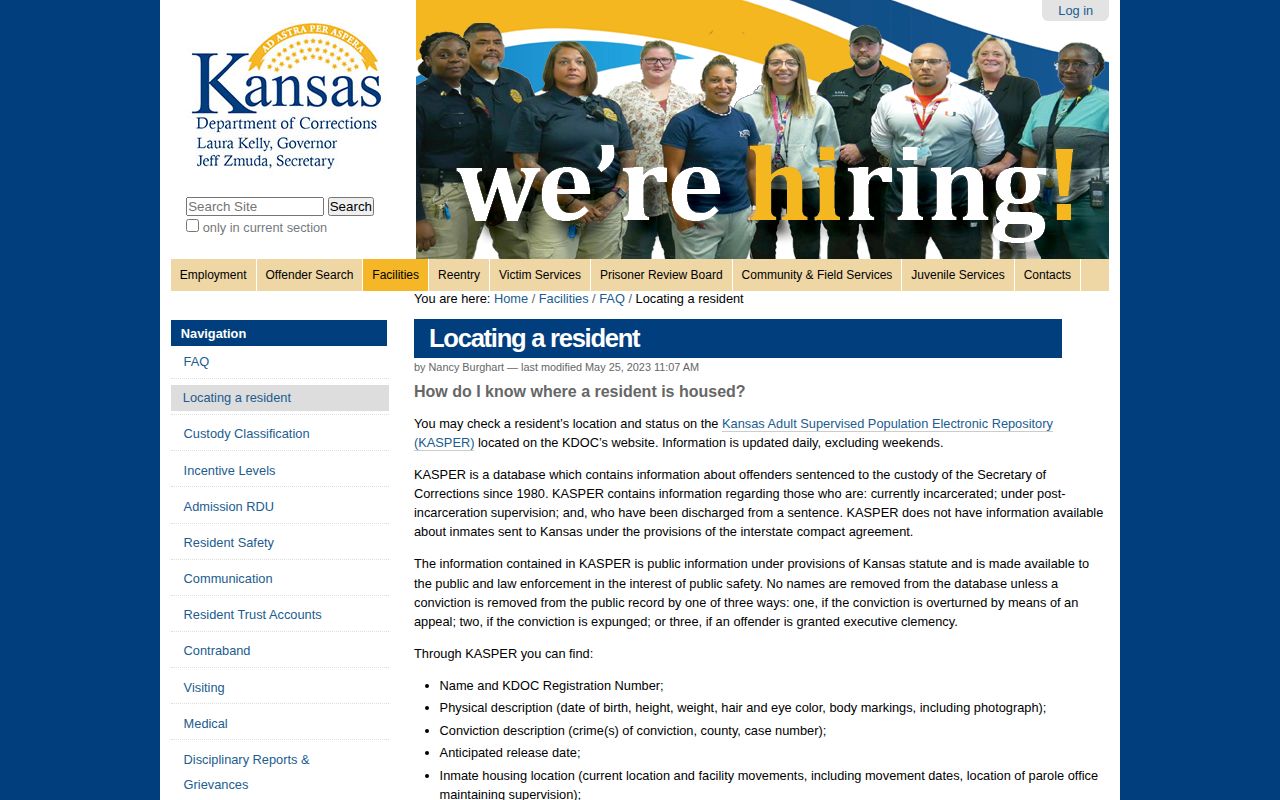
The screen is useful only after confirming that the person entered KDOC custody; it does not calculate a Stevens County Jail term.
Stevens County Sentence Computation
No single calculator covers both a Stevens County jail term and a KDOC prison sentence. For state sentences, K.S.A. 21-6821 governs good-time and program credits for covered offenders. The general maximum for covered crimes committed on or after July 1, 1993 is 15 percent. Specified lower-severity categories can have a 20 percent maximum. Credits must be earned and retained.
The common “85 percent” phrase is therefore limited. A 15 percent maximum can imply roughly 85 percent of a covered prison portion only when that rule applies and the credit is earned. A 20 percent category points toward 80 percent. Neither figure is a universal rule for county-jail terms, life sentences, old indeterminate sentences, or every Kansas crime.
Older indeterminate crimes use a different framework, including K.S.A. 22-3717 for parole eligibility and postrelease rules and K.S.A. 22-3725 for important pre-1993 credit provisions. The offense date, sentence type, mandatory minimum, consecutive structure, and current journal entry all matter.
Why Stevens County Dates Change
A date can move earlier or later because its inputs change. The public display may also lag behind an agency computation. Read the date beside its label and record the access date. A parole-eligibility date only opens possible consideration. It does not mean parole was granted.
| Factor | Effect on the date |
|---|---|
| Earned or lost credit | Authorized credit may advance a date; forfeiture may move it later. |
| Jail credit | Court-awarded time confined changes the time remaining. |
| New court order | An amended sentence or corrected journal entry changes inputs. |
| Consecutive cases | Terms served in sequence can extend the computed endpoint. |
| Detainer or hold | One custody may end while another agency immediately receives the person. |
| Parole decision | Grant, denial, or deferral affects eligible indeterminate cases. |
| Revocation | Return to custody can require a new computation. |
A detainer is an agency request tied to another custody interest. It can prevent return to the community even when the Stevens County episode ends. Ask for the receiving agency rather than calling the movement an ordinary release.
Confirm Stevens County Release Dates
For county-jail custody, Kansas VINE can provide a change alert when registration is available, but it does not cover KDOC prisons. The Stevens County VINELink inmate search explains that boundary and the PIN process. Follow any alert with a jail call to distinguish community release from transfer.
For KDOC custody, recheck KASPER and contact KDOC when a formal computation question remains. KDOC lists its Sentence Computation Unit at 785-296-3317. Give the KDOC number and name the exact field in question. Staff should not be asked to offer a broad legal opinion.
For county proof, request the K.S.A. 19-1904 prisoner-calendar entry. It identifies exact discharge time and release authority. Pair it with the journal entry when the legal reason matters. This two-record method is stronger than inferring release from a missing roster result.
Stevens County Jail Computation
Do not apply the state-prison credit framework to a Stevens County jail sentence by analogy. No Stevens County jail good-time policy was published in the official sources reviewed. Ask the sentencing court for the journal entry and the sheriff for its release computation. The journal should identify the sentence and any credit for time confined under K.S.A. 21-6615.
A focused jail inquiry should include full identity, booking date, case number if known, and the precise date field requested. Ask whether the time is a projected local release, an actual discharge, or a planned transfer. If another case or agency hold exists, request the destination. That distinction resolves many apparent conflicts.
- Anticipated release date
- KDOC’s public planning label for a state record.
- Parole eligibility
- The first possible consideration point in an eligible case, not a promised exit.
- Postrelease supervision
- A community-supervision term after the prison portion.
- Discharge
- The end of the sentence or supervision obligation shown by that system.
Stevens County Calculation Channel
A reliable calculation follows a set order. Identify every case and count. Record each offense date and sentence date. Determine whether terms run together or one after another. Add court-awarded confinement credit. Classify the sentence as determinate, indeterminate, life, or specially governed. Apply only authorized credit actually earned and retained.
Then separate release from confinement from discharge of supervision. Recheck after discipline, restoration of credit, sentence amendment, a new detainer, recalculation, or revocation. This process explains why two dates can both be accurate while answering different questions.
The Kansas Prisoner Review Board uses parole, continue, and pass for eligible hearings. An offender’s name on an upcoming public-comment list is not a decision. KASPER status after the hearing or the board action itself is needed. Determinate sentences generally move from the prison portion into postrelease supervision instead of discretionary parole.
Stevens County KASPER Date Labels
KASPER date labels are not interchangeable. “Anticipated release date” is KDOC’s verified public planning field. A parole-eligibility date identifies the first possible consideration point for an eligible indeterminate sentence. A conditional-release date has a separate statutory basis. A maximum date reflects an endpoint under the governing record. Discharge can occur later than physical release because parole or postrelease supervision continues in the community.
Read status, movements, movement dates, supervision level and office, convictions, cases, and the exact date label together. A movement from Stevens County Jail to a KDOC reception facility supports transfer, not release to the community. A status of parole, conditional release, or postrelease supervision supports community release from prison with supervision, not full sentence discharge.
KDOC warns that KASPER is not a complete Kansas criminal-history record. It also notes that certain community-corrections probation events after April 21, 2021 cannot currently display during system modernization. When that gap matters, contact the responsible community-corrections agency or court rather than treating a missing KASPER event as proof.
Stevens County Parole Date Checks
The Prisoner Review Board’s public-comment hub publishes schedules and offender lists for upcoming parole-eligibility hearings. Public comment generally precedes the hearing by one month. Appearance on a list means consideration is approaching. It does not mean the board granted release, and county of conviction does not establish current residence or the proposed return county.
The board’s terms matter. “Parole” means the board found the person suitable for release under that framework. “Continue” defers the matter for deliberation, information, evaluation, or votes. “Pass” denies release for a stated period. No consolidated public decisions database comparable to KASPER was found. Recheck KASPER after the hearing or request the individual board action.
K.S.A. 22-3717 is highly dependent on offense date and sentence type. Some sentences carry mandatory minimums, hard terms, or exclusions from ordinary parole eligibility. Life without parole is ineligible. The current journal entry and statute control, so a rough online formula cannot replace the official computation.
Stevens County Holds and Release
A county departure can lead directly into another custody. An ICE detainer is a request for notice and, in applicable circumstances, custody for a limited period beyond ordinary release. A USMS transfer can move a federal pretrial detainee from a local contract bed without placing that person in BOP’s sentenced population at once. A BOP no-result alone therefore cannot establish community release.
Ask the sheriff or KDOC for the receiving authority. Then use that authority’s channel. The BOP locator can show “Released” or “Not in BOP Custody” and a past date for covered federal records. ICE’s locator can include current detainees and people released within its recent window, but a no-result may reflect timing, identifiers, or scope. Each result answers only for that system.
ICE’s Online Detainee Locator uses an exact nine-digit A-number with country of birth or exact biographical information. It can include current detainees and people released within the last 60 days, but excludes records for people under 18 and can lag. ICE’s Detention Reporting and Information Line is 1-888-351-4024, Monday through Friday, 8 a.m. to 8 p.m. Eastern.
Federal BOP records generally cover 1982 forward. A future date can change, and a displayed past BOP release date does not prove that federal supervised release ended. USMS has no comparable public historical locator. For a federal pretrial movement, use the federal court, responsible USMS district, or formal records route.
These channels matter only when the Stevens County record documents a federal or immigration nexus. Searching every county detainee across unrelated systems creates false matches. The release or transfer sheet should determine which system deserves the next search.
Recheck Stevens County Dates
Use the responsible custody system again near the projected date. A fresh check can capture a recalculation, transfer, or status update that an older copy missed.
Public Record Search
Sponsored Results